A lot of our work at Ryse sits close to some of the wealthiest people in the world. Through our strategic audience work for the world’s leading global art fair, we’ve become experts in all things UHNWI.
One trend in the UHNWI universe has caught my eye recently; the (ahem) soaring demand for private aviation. Demand so strong, in fact, that it’s completely outstripping supply. As a growth strategist, that got me thinking, how can brands operating in private aviation and beyond maintain growth in the face of supply bottlenecks? It turns out that Amex, Ferrari and Wimbledon can provide some helpful lessons...
Demand for private flights is taking off
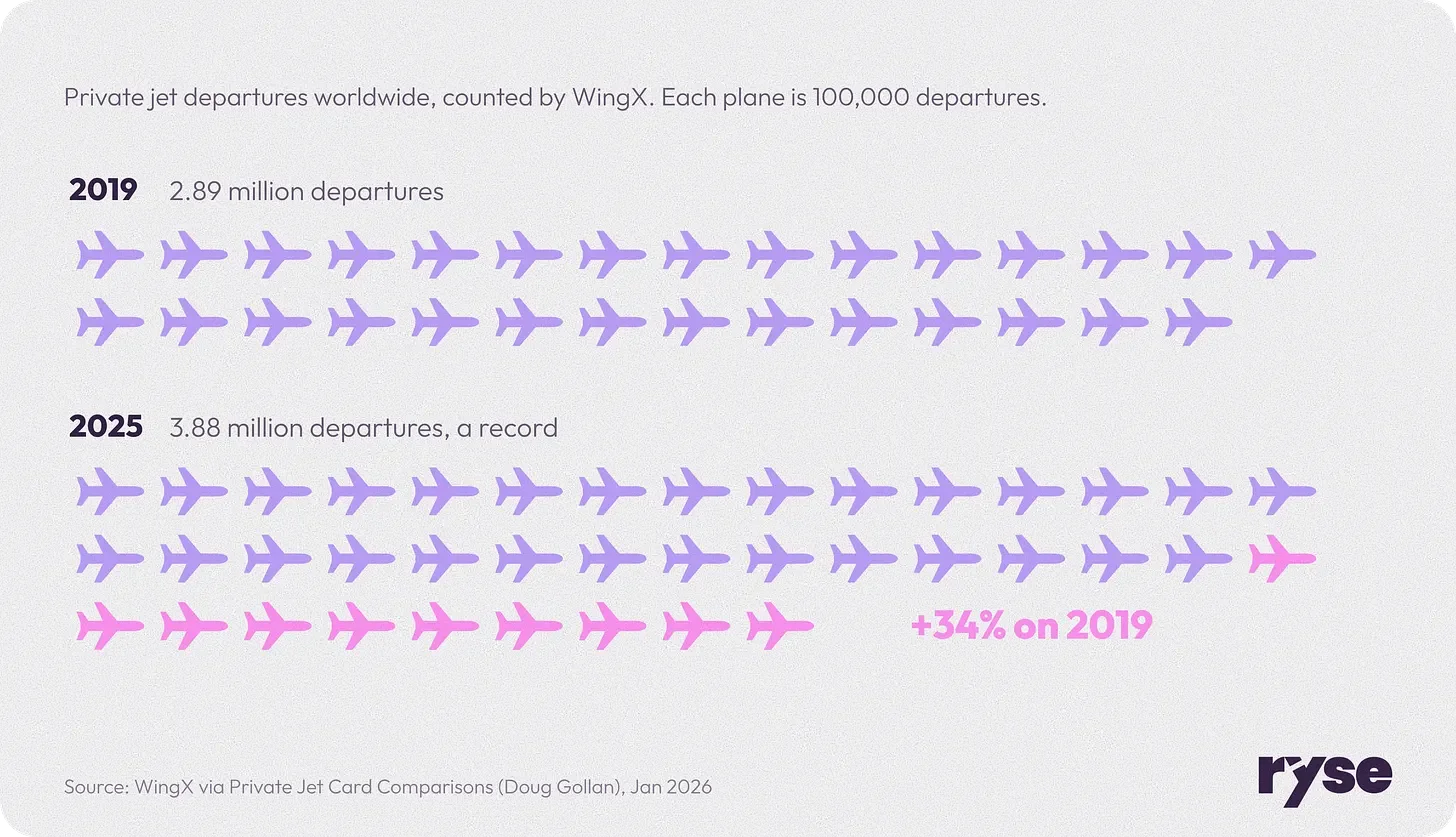
Private jet flying hit a new record in 2025. WingX counted around 3.88 million flights worldwide, about a third more than before the pandemic. Flexible access models in particular are seeing surging demand, with Magellan Jets reporting a 55% increase in new Jet Card clients in the first half of this year alone.
The reasons aren’t complicated. According to Wealth-X, the number of ultra-high-net-worth individuals (people worth $30m or more) grew from just under 300,000 in 2019 to more than 510,000. Over the same period, US corporate profits rose 94%, and C-Suite folk are increasingly rejecting video calls (‘You’re on mute again Mike...’) in favour of in-person meetings, even if they’re 3000 miles away.
But there’s a problem - supply just can’t keep up.
The wait for the most sought-after new jets runs 18 to 30 months, and pilots, mechanics, hangars and ramp space all have hard limits. As a result, operators are being forced to limit on-boarding new customers, which raises a question. If you can’t grow by selling more of your core product, how do you grow?
Growing revenue per customer isn’t new. But it’s getting a lot more interesting
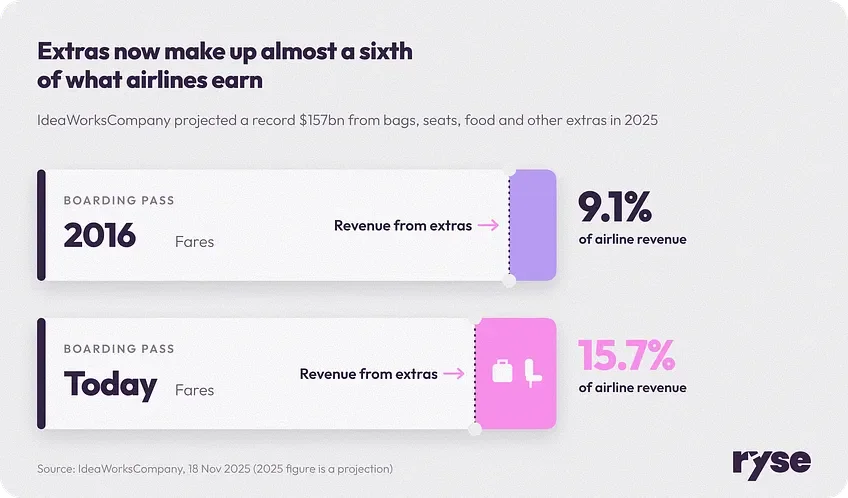
We all know airlines have been at this for years. Paying extra to choose your seat, check a bag or pre-order a sandwich is just part of flying now. And it adds up: airlines were projected to earn $157 billion from “extras” in 2025, around 15.7% of their total revenue, up from 9.1% in 2016.
But this goes far beyond a £9 sandwich at 35,000 feet. Luxury brands have become masters at extracting more value from each existing customer relationship.
One of the best models of monetising your audience relationship I’ve come across is from Amex. In 2019, Amex bought Resy, the restaurant booking platform. Today, Platinum cardholders can get reservations at some of the hardest-to-book restaurants in the US, tables you simply can’t get otherwise.
Why do restaurants go along with it? Because it works for them. Since the Resy benefits launched on Amex cards, cardholders have spent 25% more at participating restaurants.
Everyone wins. Cardholders get something money can’t easily buy. Restaurants get their most valuable guests. And Amex sits in the middle, giving people another reason to hold the card and learning what its best customers love. I’d call it an “access marketplace”, and private aviation is almost perfectly set up for one.
Ferrari gives us another interesting example. It shipped slightly fewer cars in 2025 than the year before, yet revenue grew 7% and profits 12%. Ferrari has largely been able to do this by upselling customers along their ladder of increasingly expensive personalisation programs. Most buyers start in the ‘Atelier,’ where they can choose from a curated menu of colours and finishes. ‘Tailor Made,’ the next rung of the ladder, gives a limited number of clients the opportunity to work with their own personal designer in the studios in Maranello, New York and Shanghai to configure their dream Ferrari, adding up to 100% of the base car price. At the very top of the ladder, one or two clients a year are allowed to build their own fully bespoke ‘Special Project’ Ferrari, sometimes snowballing to an eye-watering $3M.
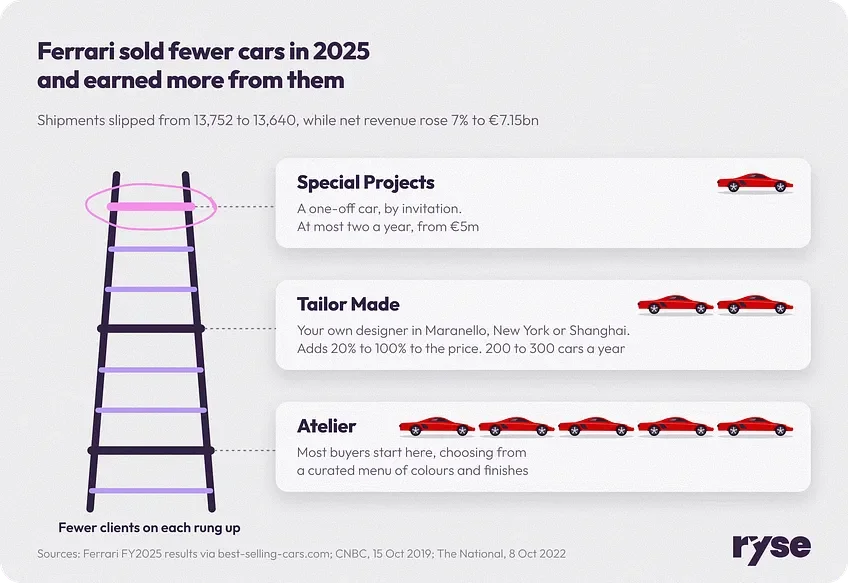
The luxury twist is that Ferrari barely markets any of it. Access to the top rungs is earned. Ferrari tracks what you’ve bought and whether you come to its events or race with it, and only its very best clients are invited to commission a one-off. The personalisation isn’t just a product; it’s a reward for the relationship.
Closer to home, Wimbledon has been doing this for nearly a century. Centre Court can’t get any bigger, and demand to sit on it far outstrips the seats available. So rather than chase more customers, the All England Club sells its scarcest asset years in advance to the people who value it most in the form of debentures.
Its latest debenture issue offered 2,520 seats at £116,000 each (many multiples of the value of the underlying day-tickets), covering five Championships from 2026 to 2030. That’s 45% more than the last issue, and it still sold out, raising around £292 million. Holders get a guaranteed seat on the same tier as the Royal Box, parking and use of private restaurants (strawberries presumably included). The clever bit is in how Wimbledon is using the upfront cash that debentures provide: to fund extra capacity by expanding onto the neighbouring Wimbledon Park.
So, what has this taught us? It seems there are two broad ways brands can extract more revenue from each customer. You can charge more for less, unbundle what used to be included, and hope nobody notices. Or you can elevate: charge more for more, by giving your best customers something they genuinely value.
Amex, Ferrari and Wimbledon all chose to elevate, and between them they offer three lessons that apply far beyond the runway. First, your customers are worth more than what they buy from you: the right partners will pay to reach them. Second, value isn’t evenly spread, so your offer shouldn’t be flat: some customers will happily pay far more, if you give them a ladder to climb. And third, loyalty can fund growth: your most committed customers may be willing to pay today for guaranteed access tomorrow. All of this, of course, is predicated on knowing exactly who your best customers are, what they value, and who else would value them.
None of it works if you treat every customer the same. That’s the work we do at Ryse: finding the customers worth building the ladder for, and what would make them climb it.
Until then, I’ll be in seat 32F, eyeing up the £9 sandwich.