
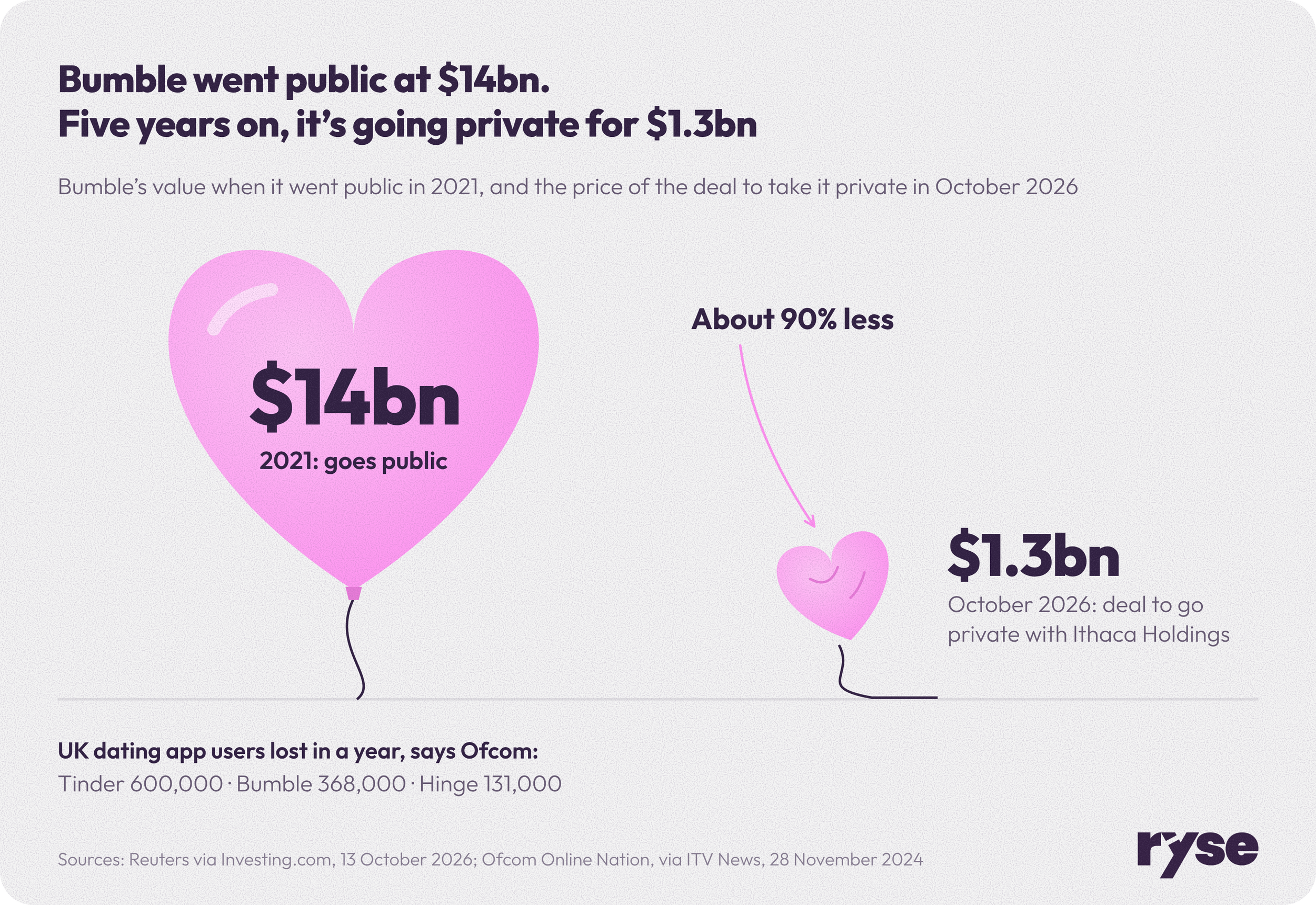
To news this past week that Bumble just sold for 90% less than it was worth at IPO. This caps a 5+ year trend away from singles using algorithms to find their lobster (IYKYK). In 2024 research indicated that 1.4m people in the UK had quit dating apps – a trend reflected around the world. And as far back as 2021 Dutch researchers uncovered what – I suspect – is the reason that sits behind this shift. They discovered that the more dating profiles people see, the more likely they are to reject them.
This got me thinking about jam.
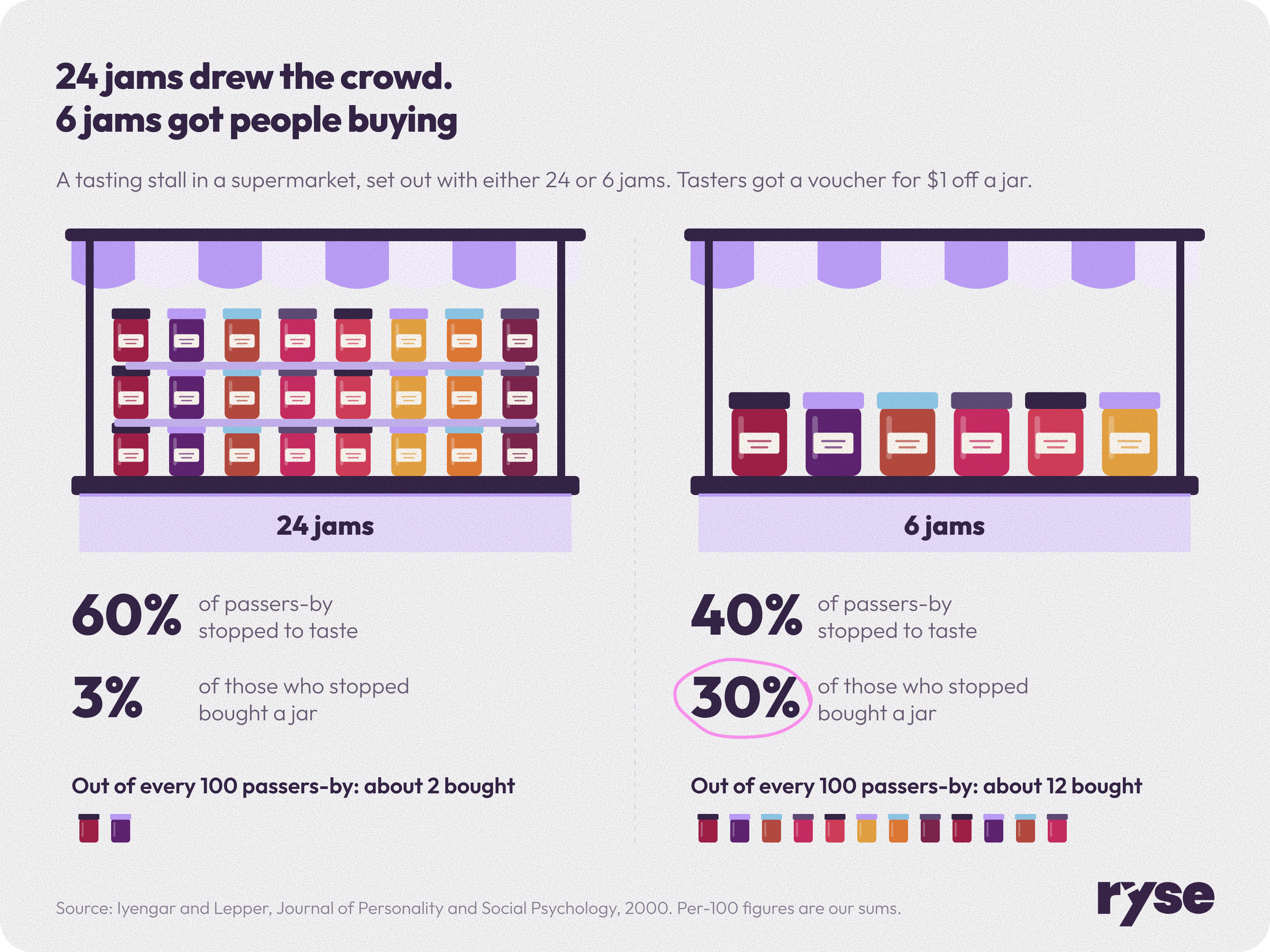
In 2000 a group of researchers experimented with the dynamics of decision architecture and the choices we make, using jam. In short, the researchers created two stalls selling jam: one with 24 jams on display; the other just 6 jams on display. Shoppers could taste as many as they liked and were handed a voucher for a dollar off any jar. The big display won the attention battle comfortably: around 60% of passers-by stopped to have a look, compared with 40% for the small one. But when it came to actually buying anything, the result flipped. Only about 3% of people who stopped at the 24-jam table went on to buy a jar, against roughly 30% of those who saw just six.
Methinks Bumble – and indeed many dating apps – fall foul of this: they present so many options – too many options – and people get snow blind. Back to our Dutch dating app researchers, they concluded “the seemingly endless stream of options can increase feelings of dissatisfaction and pessimism about finding a partner, which in turn leads to rejecting potential mates”.
The same conclusion about choices and decision architecture was reached by Barry Schwartz – author of The Paradox of Choice. He similarly concluded that as you offer more options, people not only find it harder to make a choice in the first place, but then when they finally do make a choice they are less satisfied with their choice as they continue to mull all the possible choices they didn’t make. All the roads not taken. He concludes “Autonomy and freedom of choice are critical to our well-being, and choice is critical to freedom and autonomy. Nonetheless, though modern Americans have more choice than any group of people ever has had before, and thus, presumably, more freedom and autonomy, we don’t seem to be benefiting from it psychologically”
So then to an article I read last week looking at the boom in high-end match-makers for the newly-minted AI millionaires of Silicon Valley. Turns out some of them are dropping as much as $500,000(!) on consultants and coaches to help find their partner. Whilst it’s tempting to laugh at the funny little robot-boys and their inability to “interface” with “humans” (whilst strip-mining the world’s collective knowledge and water supplies), I think there is a more important underlying lesson: we all want greater curation of – and support in making – decisions.
So, what does this look like for businesses that aren’t charging Silicon Valley-types half a million dollars to find a girlfriend? As far as I can tell, there are two ways to go about it. The first is to do the choosing before the customer arrives, by being ruthless about what you offer in the first place. The second is to put a human in the middle, someone who knows what they’re talking about and can help people choose, rather than leaving them to the mercy of an algorithm and an infinite scroll.
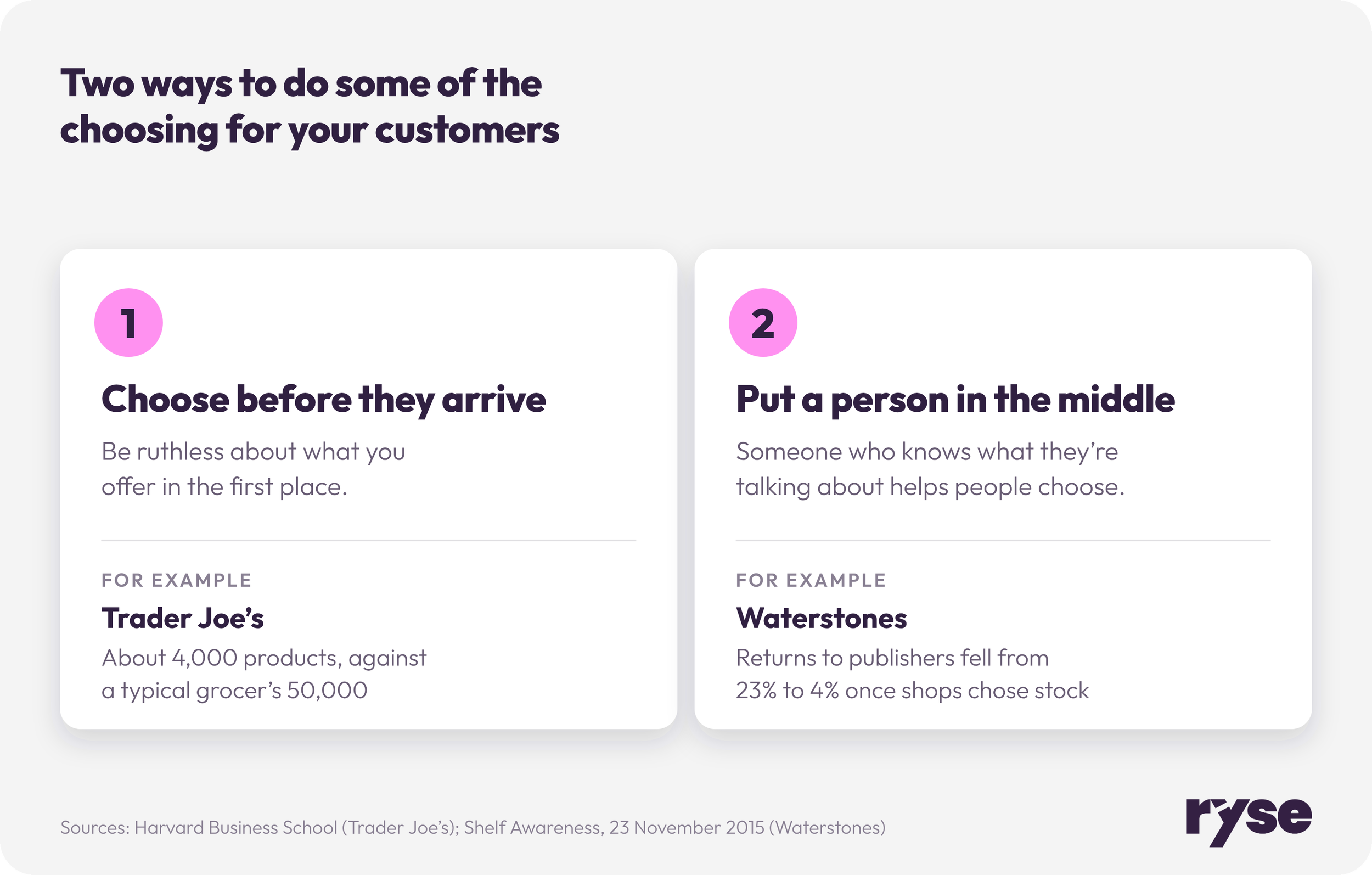
The first is essentially portfolio management, and supermarkets are a good reference here. Trader Joe’s, the American grocer with a following that borders on the religious, carries around 4,000 products against the tens of thousands in a typical supermarket. Its stores are a fraction of the size of Whole Foods’, yet its sales per square foot have historically been estimated at close to double. Closer to home, Aldi has gone from the UK’s tenth largest food retailer with under 2% of the market around twenty years ago to passing 11% for the first time. Yes, price is doing a lot of the heavy lifting there, but the narrow range is what makes the price possible in the first place.
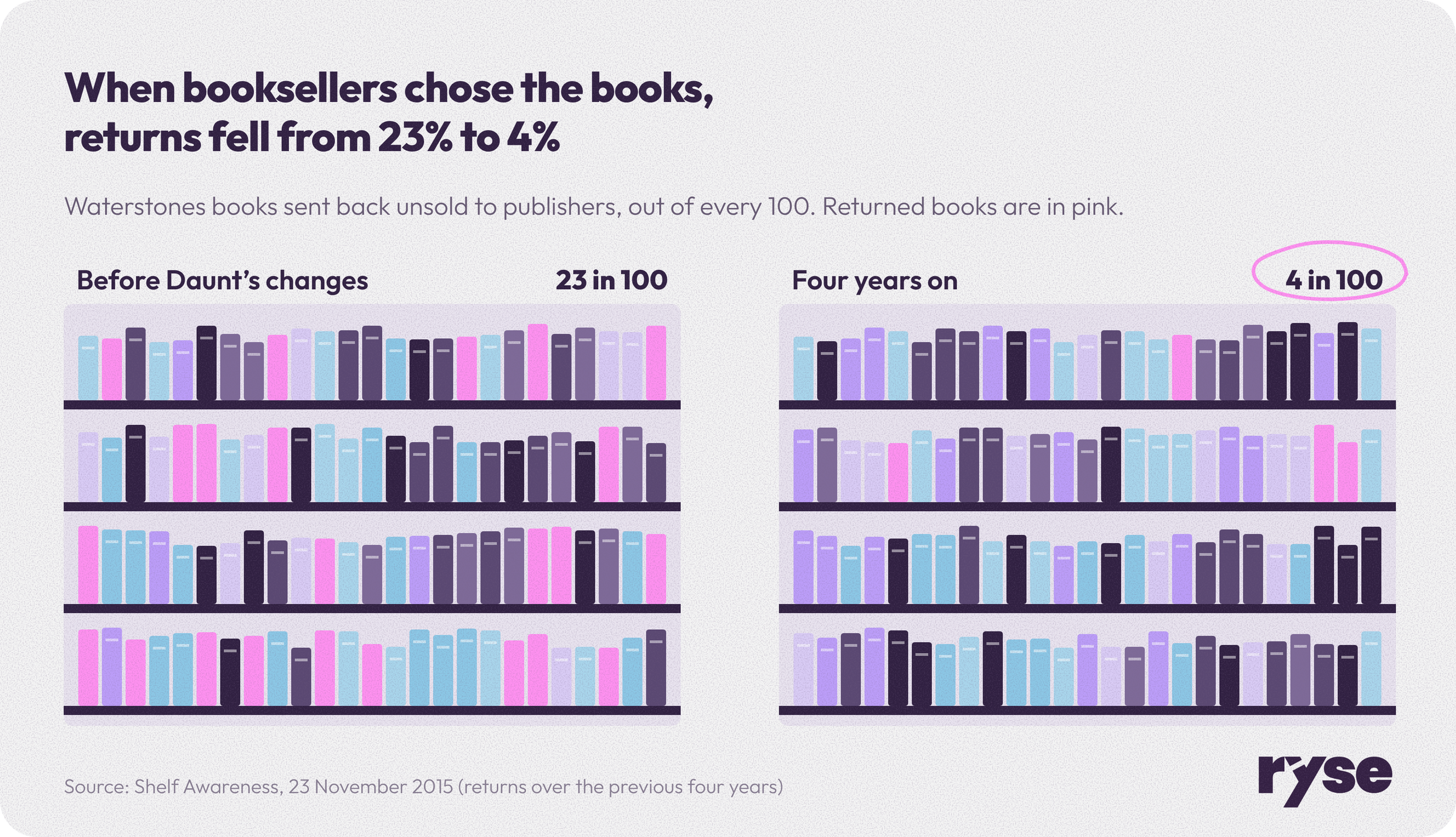
The second is about humanising the experience, and the best example I can think of is bookselling. When James Daunt took over Waterstones in 2011, the chain was losing money and closing shops. One of the most important things he did was let booksellers buy the titles that suited their own shop, rather than letting publishers pay for space on the tables. His view was that the recommendations that would get you laughed out of Middlesbrough sells by the bucketload in London, and only the people in the shop know which is which. The share of stock sent back unsold to publishers fell from 23% to 4%, and in the year to April 2016 Waterstones made pre-tax profits of £12.9m, its first profit in five years. He’s since run the same playbook at Barnes & Noble, handing each store to its local booksellers, complete with their own displays and handwritten staff recommendations. In 2024 it opened 57 stores, more in one year than in the whole of 2009 to 2019. Not bad for an industry Amazon was supposed to have finished off.
So where does that leave us? The instinct in most businesses is that more is generous. More options, more features, more profiles to swipe through. But the evidence keeps pointing the other way. People don’t want infinite choice; they want someone they trust to have done some of the choosing for them. Not only does this help them actually make a choice in the first place, but – crucially – it’ll leave them feeling good about the choice afterwards. Whether it’s who to go on a date with, what book to read next, or which jam to spread on your toast.