Someone has to keep an eye on the treacle sponge
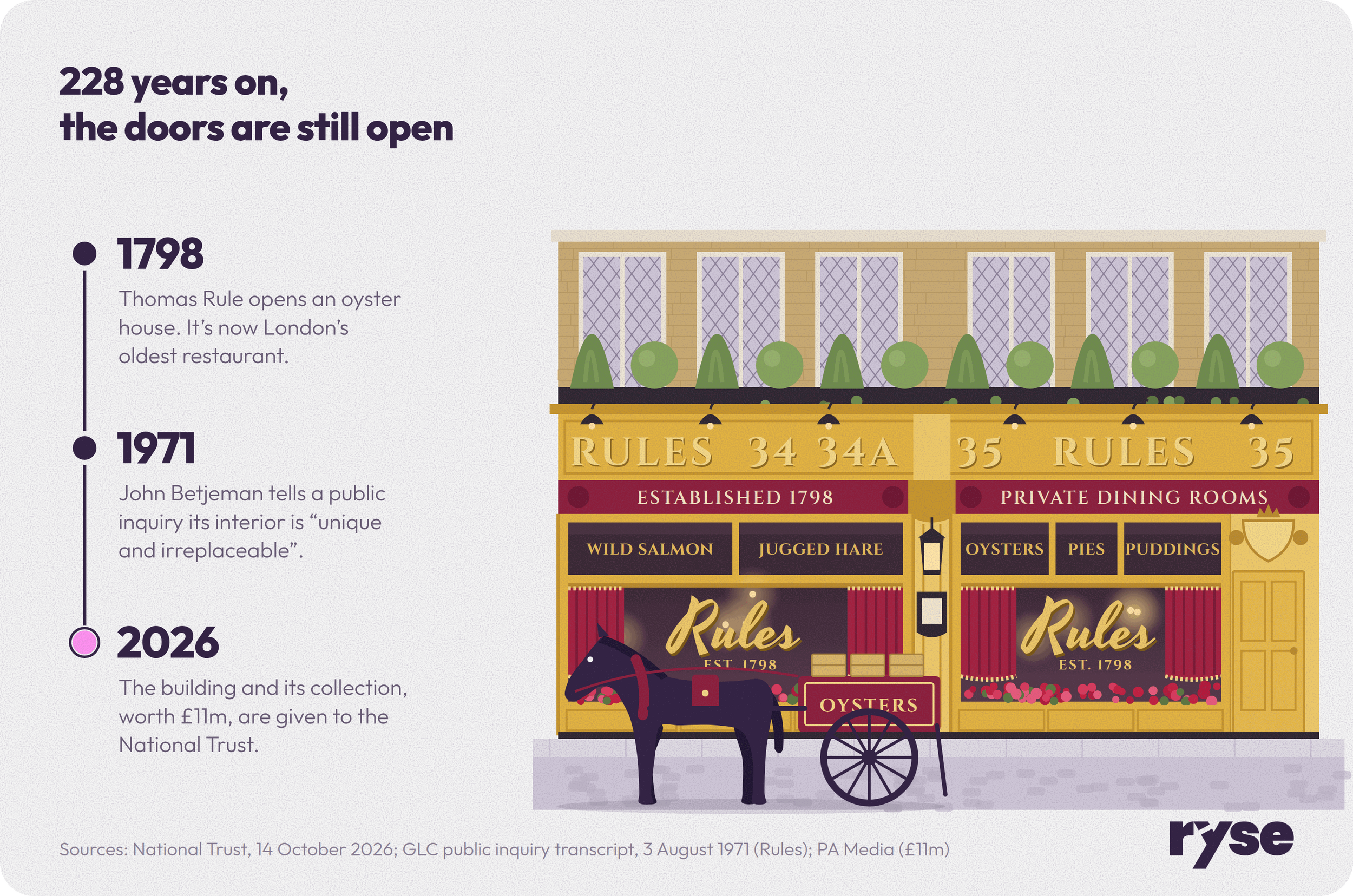
On 3 August 1971, John Betjeman gave evidence at a public inquiry to save a restaurant. The Greater London Council wanted to turn the Strand into a dual carriageway, and Rules, on Maiden Lane in Covent Garden, was in the way.
Betjeman said it was a great restaurant, but actually his case to save it rested on something else. The ground-floor interior, he said, was unique and irreplaceable, and you couldn't just pack up the paintings, prints and fittings and put them in a new building.
Rules opened as an oyster bar in 1798, and last week the National Trust announced that the owner, J-P Mayhew, had given it the building. The £11 million gift also includes the restaurant's collection of visitor books, menus, caricatures, photographs, stained glass and signs. The Trust's director-general, Hilary McGrady, said it had "defied the odds to be standing here today, doors still open and treacle sponge still on the menu." Mayhew also said the Trust would protect its "invisible atmosphere" (The Guardian).
This got me thinking, most businesses have an invisible atmosphere of some kind, but many of them don’t know how to protect it.
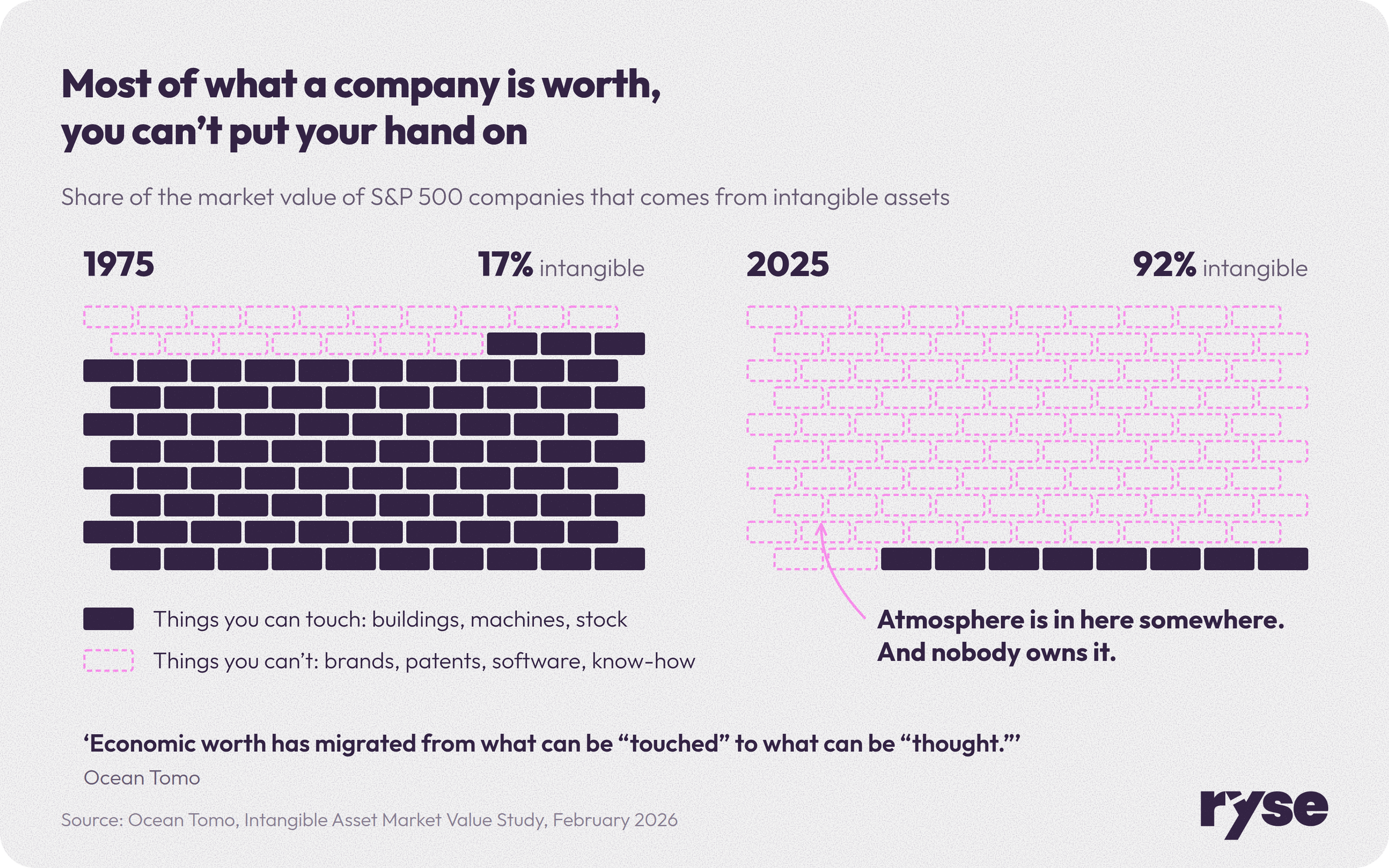
The advisory firm Ocean Tomo tracks how much of the market value of S&P 500 companies comes from intangible assets. In 1975 it was 17% but in 2025 it was around 92% (Ocean Tomo). This means that most of what big companies are worth now, you can't stand in or put your hand on, or as Ocean Tomo says, ‘economic worth has migrated from what can be “touched” to what can be “thought.”’
Atmosphere is only a small part of that, but it's also the part with the least protection. A brand has a marketing director and a patent has lawyers, but the feeling of walking into a room that has been busy since 1798 belongs to nobody. It isn't on a dashboard or in a forecast, nobody notices it until it's gone, and by then the people who came for it have stopped coming. When I’m walking around the back streets of London, I often joke that it ‘smells like history’, it’s that smell that makes a place special.
The obvious way to protect that special feeling is to ask customers what they love about your brand and protect that, but the trouble is that they often can't tell you.
In a study published in Nature in 1997, a team put four French and four German wines side by side in a supermarket, then played French and German music on alternate days for two weeks. On days with French accordion music, French wine sold better. On German music days, German wine outsold French. Afterwards, shoppers were asked, "Did the type of music playing influence your choice of wine?" Only 13% said yes (New York Times, 1997; Nature).
The music was doing the selling but the people being sold to didn't notice. If you'd asked them what to keep in the shop, the music would probably never have come up. Atmosphere works the same way, customers feel it, but they rarely name it.
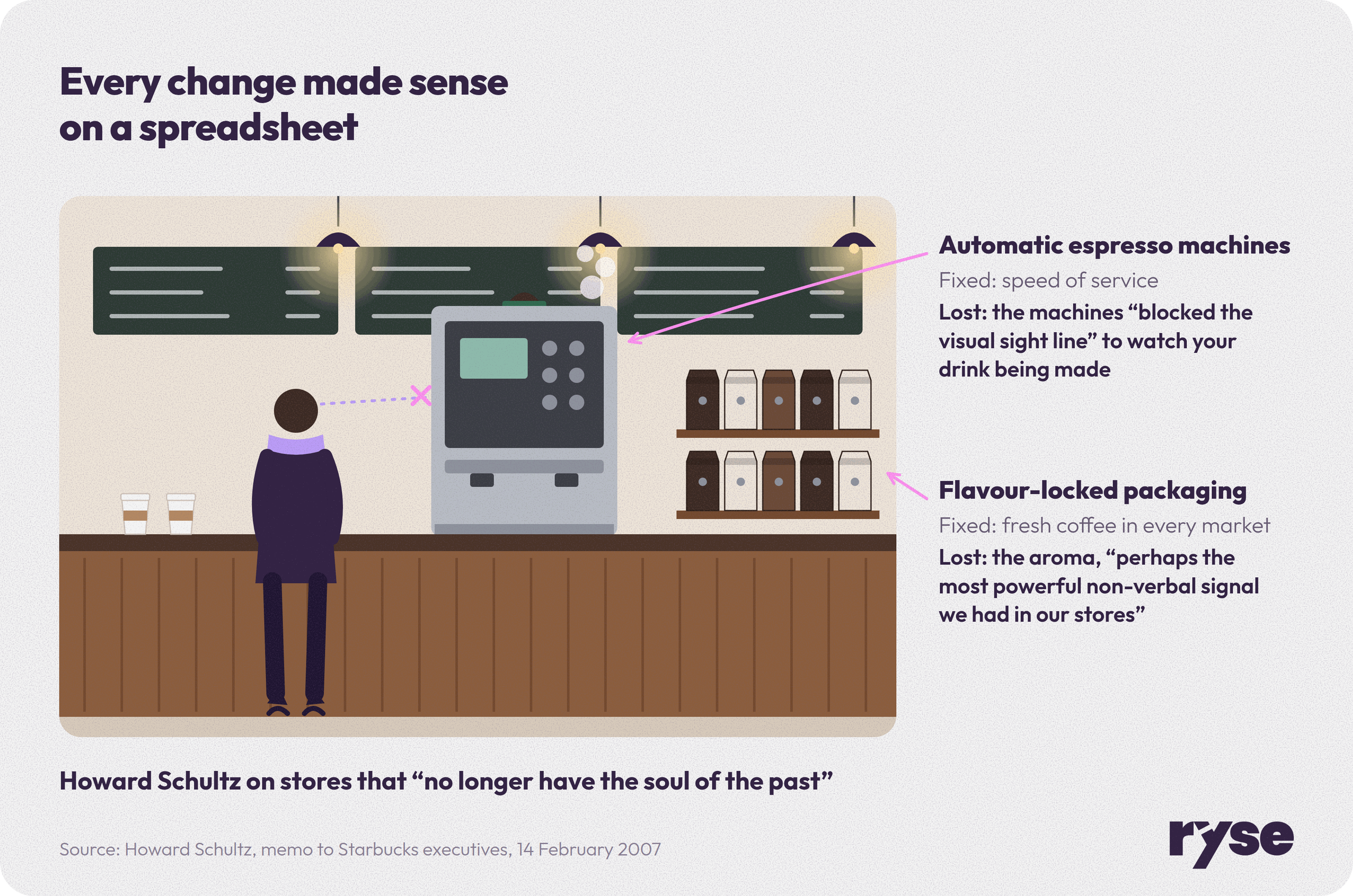
On 14 February 2007, Starbucks chairman Howard Schultz sent an email to the company's top executives (AP). In it he went through a list of changes that had been made which increased efficiency (automatic espresso machines, flavour-locked packaging) but had impacted the brand experience (customers couldn’t see their drinks being made, and the shop didn’t smell like coffee). Schultz recognised they had lost "perhaps the most powerful non-verbal signal we had in our stores", and Starbucks sites “no longer (had) the soul of the past" (the memo).
Nobody had set out to change the brand feel, and every change made sense on a spreadsheet, but the spreadsheet had nowhere to record what was being lost.
Most businesses don't have a charity to look after their atmosphere like Rules now has, but they do have the same choice to make, every time someone proposes a faster road through the middle.
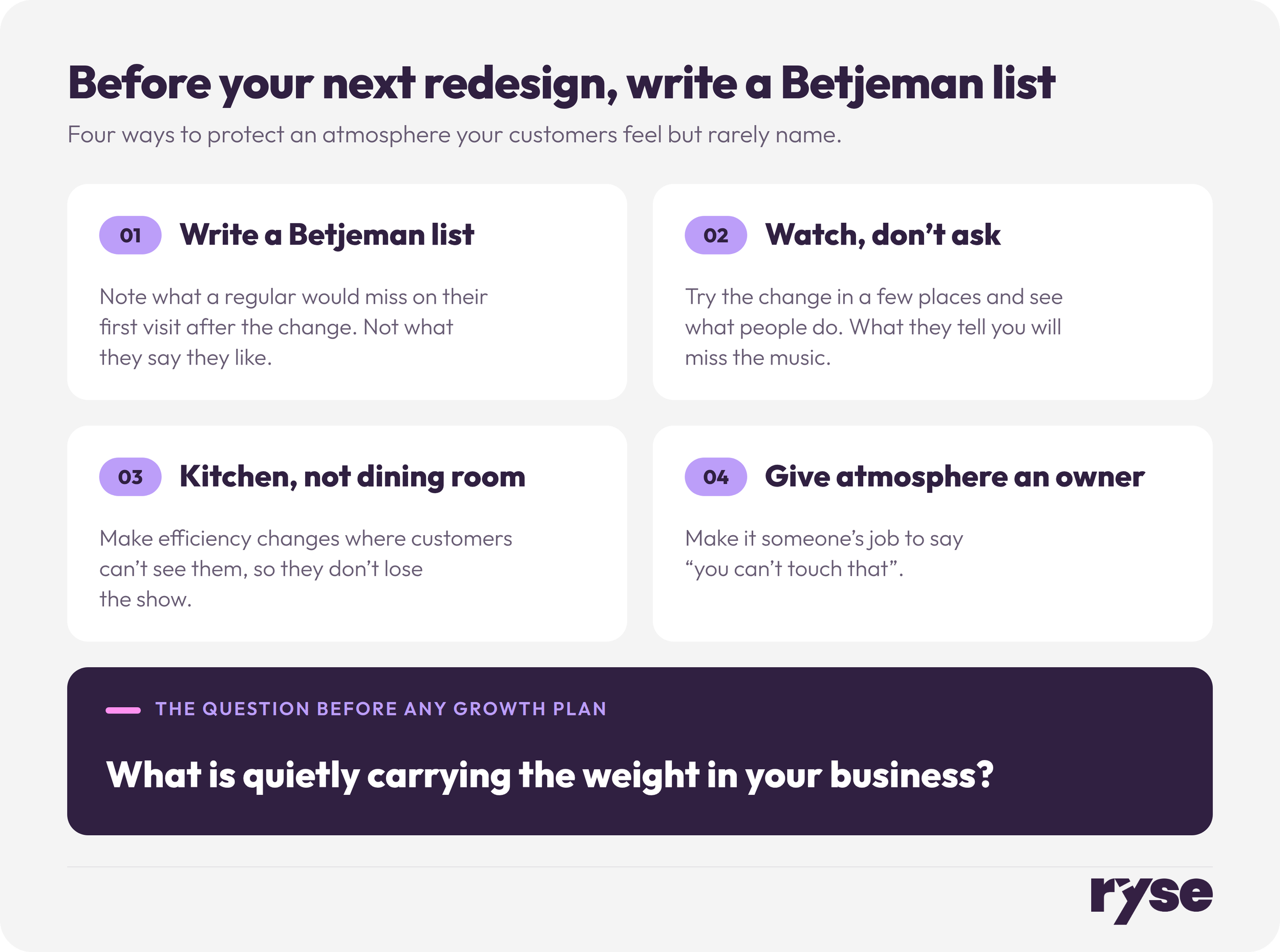
Before your next redesign, rebrand or efficiency drive, write a Betjeman list. Put down the things a regular would notice had gone on their first visit after the change. That isn't the same as what they say they like, nobody at the supermarket would have put the accordion music on theirs.
Then watch rather than ask - try the change in a few places and look at what people do, because what they tell you will miss the music.
Where you can, make efficiency changes in the kitchen rather than the dining room, so to speak. Schultz's espresso machines fixed a real problem, but they fixed it in front of the customer, and the customer lost the show.
And give the atmosphere an owner. Rules now has a charity whose job is to protect it. In most businesses, it's nobody's job to say "you can't touch that", so nobody does.
A lot of our work at Ryse starts with exactly this question: what is quietly carrying the weight in a business, before a growth plan runs a road through it?
Somebody has to keep an eye on the treacle sponge. I've volunteered.